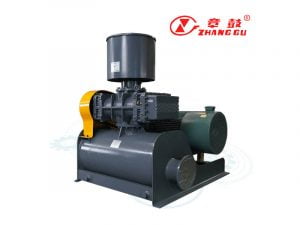
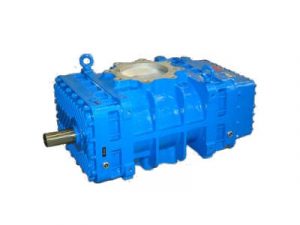
Positive displacement Roots air blowers
Roots blowers have advantages over centrifugal (side channel) blowers.
These blowers have a longer life of up to 20 years. There are cases of these blowers running for 40 years with good service maintenance.
A rotary positive blower, also called a positive displacement blower, or PD blower "pushes" a relatively constant volume of the gas from the inlet to the discharge (outlet). Gas is not compressed as in a compressor. The volume of gas the machine pumps is determined by the configuration of the casing and rotating parts.
Flow through a PD blower is constant, irrespective of pressure changes. This is different from a centrifugal compressor that maintains a constant pressure while the flow varies.
Variable speed motors or variable speed drive (VSD)
A VFD can be very effective on a PD machine. The reduction in electrical power consumption is much less than it would be with a dynamic machine (like a fan or centrifugal compressor), but it can still be substantial.
Roots blower parameters
The below graphs illustrate the details you need to consider when selecting your blower.
- What is the volume of air required (cubic metres per minute, m3/min., lpm or other units);
- What is the required pressure delivery. There are many units here. In aquaculture this is typically mm Aq (millimetres aqueous water at temperature) or metres of water that the air can discharge at. (Also Bar, Torr, kgf/cm², ATA, ATM, and for vacuum, mm Hg or millimetres mercury) ;
- For both of the above you have different sized roots blowers, different rpm (revolutions per minute) of the electric motor and different size motors
From the above curves you can see how for a specific pressure delivery, bigger motors and higher rpm’s are needed as the air volume delivered increases.
Typical pipe sizes and motor sizes
|
Outlet Diameter (inch)
|
Max. capactiy (m³/min)
|
Max. Pressure (kgf/cm² )
|
Max. Motor (HP)
|
|
1.5''
|
0.97
|
0.3
|
1
|
|
2''
|
2.94
|
0.5
|
5
|
|
2.5''
|
5.17
|
0.5
|
7.5
|
|
3''
|
7.96
|
0.6
|
15
|
|
4''
|
11.80
|
0.5
|
15
|
|
5''
|
19.8
|
0.6
|
30
|
|
5''
|
25.2
|
0.6
|
40
|
|
6''
|
30.0
|
0.5
|
40
|
|
6''
|
36.4
|
0.6
|
50
|
|
8''
|
42.1
|
0.6
|
75
|
|
10''
|
65.9
|
0.6
|
100
|
|
12''
|
89.3
|
0.6
|
150
|
|
12''
|
117.8
|
0.6
|
200
|
|
One kgf/cm² = kilogram-force per square meter = 10 metres of water
Due to our international environment there are typically conversions needed such as horsepower to kilowatts; inches to centimetres etc.
Applications and use
Pneumatic conveying of bulk materials
In suction- or discharge pressure. Machine sizes range from small blowers installed in tank vehicles to very large ones used in pneumatic elevators for vacuum operated ship unloaders. The hourly capacity of such unloading installations is up to 1000 tons at present.
Aeration
Any aquaculture unit can use these blowers for aeration of ponds, tanks, dames, etc.
Pressurized aeration of basins in sewage treatment plants
Filter flushing blowers in drinking water production plants
Gas boosting blowers rated for internal static pressures of up to 25 bar.
Steel production
Application in direct-reduction plants.
High vacuum boosters
Equipped with special shaft seals.
Conveying of practically all gases
Found in the chemical, petrochemical, and metallurgical industries. Special designs are available to handle aggressive gases. Machines used in both conventional and nuclear power plants comply with the various categories of safety regulations
Technical
See, CONTROLLING POSITIVE DISPLACEMENT PUMPS
|